
My friend Mai is a graduate student, studying education. She recently asked me how I define “administration,” and what does “leadership” mean to me?
She hit me at a good time. I’ve been thinking about this stuff a lot lately.
An administrator creates pathways for people to do the work needed, I responded. They ensure that there are appropriate staffing levels and ample resources to do the work.
At the root, a leader understands the mission of the organization and works to get everyone on board so they can achieve that mission. Ideally, leaders think big and they fire everyone up to reach that potential.
Leadership becomes hard to assess because there are so many different ways to lead. There are stabilizers, motivators, visionaries and tyrants, amongst many other types of leaders. You can be the buddy-buddy boss, the boss who barks orders, or something in between.
Not everyone is a good leader, regardless of intent. Most people get very little training in leadership, so we build our personal styles based upon our experiences with past and present leaders, for better and worse.
I’m about 20 months removed from my last leadership position, as the associate dean for academic affairs in Japan, and I’ve been doing some reflection and introspection.
I think that the folks at the Japan campus liked me. I know I had a great time. But I can’t help but wonder if they thought I was a good leader, an effective administrator, a combination of both … or none of the above.
Welcome to my existential crisis.
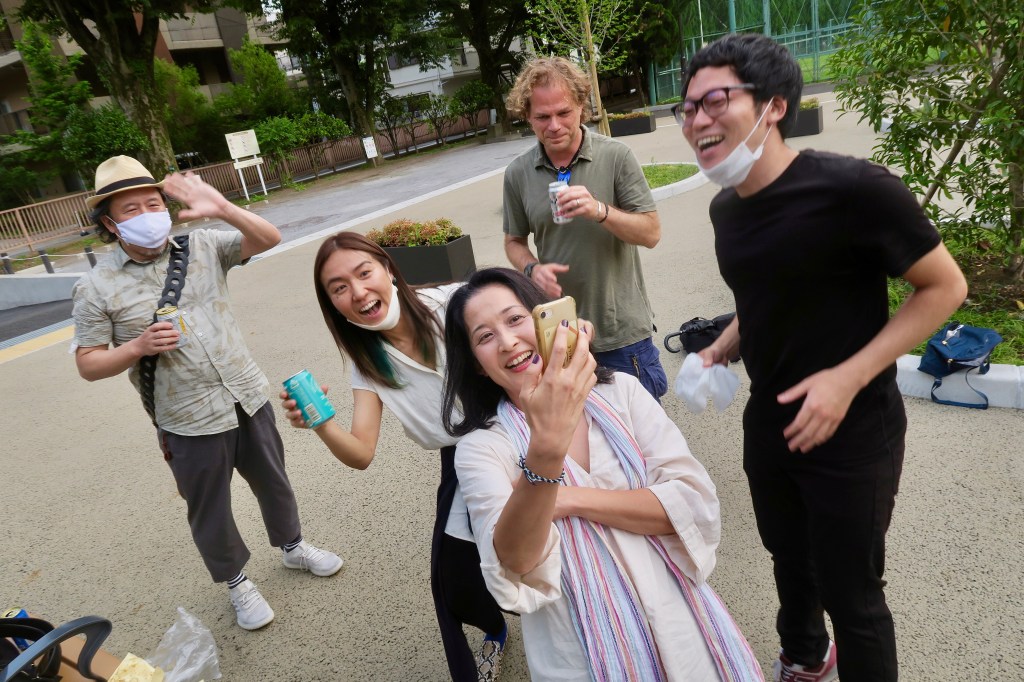
When I first began teaching in the early 2000s, I had to make a decision about how to approach classes: Would I be the stern, parental-type teacher or the encouraging buddy? I wasn’t a parent then and I had no idea how to be stern. I’m clearly not a no-nonsense type of person.
So, I tried to harness my pro-nonsense personality to make education seem entertaining and exciting.
I built on that pedagogical approach (which I actually stole from some of my favorite profs) and took it into my classes as I became a full-time teacher, especially when I taught the 300-student lecture hall class Journalism & Society. It was a pretty dreadful learning environment, so the only way to keep people interested was to make it fun.
I get loud in my classes. I ask a lot of questions and I encourage students to engage. I punctuate conversations with sometimes surprising exaltations intended to get attention but also meant to emphasize specific points.
The challenge is to make it real and not just a show. Fortunately, I love the stuff I teach about – journalism, society, community, photography, Philly, Japan, etc. I’m pretty sure I come off as genuine, if not completely and absurdly sincere.
But I really have no idea. Academia is an oddly isolating industry.
Very few of my colleagues have actually seen me teach. I read the student evaluations but they are not always reliable – I’m pretty sure most students fill out the forms super quickly. Comments generally focus on gut reactions (i.e. “George is the man!”) more than practical analysis (“I wish he would end classes with slides that summarize the key takeaways from the day, as I sometimes wonder if there is a purpose to the discussions.”).
It’s been 20+ years since I taught my first class. Over the years, I have honed a classroom personality that I feel so comfortable with that it’s hard to turn off.
Maybe it’s just who I am?
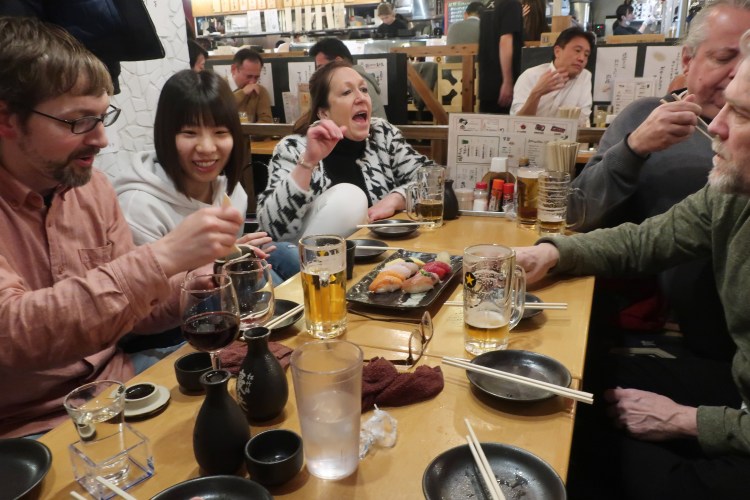
On my first day at the Japan campus, the dean asked me, “How will you be able to lead a group of people with Ph.Ds if you don’t have one?”
What a mind-fuck, eh?
I mean, I had sold my house, gave away all my stuff, handed over my magazine and left all my loved ones on the other side of the planet. And he was telling me I wasn’t qualified for the job?
He was trying to chop me off at the knees, to make me feel inferior from the beginning. It was shrewd. Pretty brilliant, actually.
Fortunately, I’m not that smart, so I didn’t see his intent right away. I simply replied with something about acting like colleagues and helping people do their best work or whatever. I moved on immediately but banked the moment.
I circled back a few days later. Rather than be angry or hurt or even discouraged, my very first thought was, “Don’t ever be that guy.” Don’t undermine people. Empower them. Be the person who lifts people up and celebrates their accomplishments. Don’t feel threatened by other people’s successes. Revel in them.

Within a few weeks of being in Japan, I realized that there was a disconnect between the faculty and staff and the upper administration. There was a lack of trust on both sides. Discourse was practically nonexistent and that hampered the daily operations. The place felt tense. Even cabinet meetings were full of shouting. It was surreal.
I took my happy-go-lucky self and offered transparency, kindness and competence. Where people had previously been ignored, I listened. Where people previously felt uninformed, I gave them information. Where people previously felt bullied, I presented humility.
My leadership style followed my teaching approach: Get people involved, make it fun and get things done. Like with JUMP, the goal was to build the community.
Now, I can be and have been an obnoxious prick at times. I can be dense and stubborn. There were times when I was running the magazine that I let my frustrations show in staff meetings. I even lost it in Journalism & Society one time, telling two students to “shut the fuck up or get the fuck out” (the two were stunned; the rest of the class applauded). I’ve made lots of mistakes along the way and I’ve tried to learn from them.
What I’m saying is that I’m not perfect. I’m just the writer here.
But it didn’t take a genius to see that transparency and kindness were what was needed at the Japan campus.
I spent the next three years talking through ideas with people, trying to build up morale, as that would ultimately make the student experience better. I hope people felt like they had a supporter in their corner.
Did it work? I think so?
Or did I totally misread the place, and there were no problems when I arrived?
My brain hurts.

I came back to Philly in 2021 and quickly fell into my old routines – same baseball team, same softball team, same basketball game, back with old friends again, etc.
I worked on my doctoral dissertation for the next year while raising my newborn, all during the later stages of the ongoing pandemic. We didn’t go out much since Kenzo was so young and his immune system wasn’t ready for the world just yet.
I had lots of time to think about my time in Japan. What did I experience there? It was a whirlwind, even before the pandemic. I was overseeing 10 majors and 7 other academic units (the advising office, registrar’s office, library, etc), and working with three graduate programs. I taught a class or two every semester and I was a doctoral student at the same time.
How do you even assess leadership?
It believe it starts by understanding the parameters going in. You know, what needs to be accomplished? What are the goals?
I looked back at the job description and my contract and it seemed I had met the desired goals – greater connection to the main campus, improved academic quality at the Japan campus, make the campus academic operations work smoothly, etc.
I think people (students, faculty and staff) felt safe talking to me, and I tried to remedy problems. We built some cool programs and did fun stuff together. I feel like the overall campus climate was much more friendly.
But who knows for sure?
Fortunately, my kid is frickin’ adorable, so I haven’t worried about this too much.

All of Mai’s questions about leadership are weirdly relevant for me now, as I’m about to embark on my next leadership position. Starting in July, I will be the associate dean for academic affairs at the Graduate School of Journalism at Columbia University.
Say what?
It sounds so strange to even think about. Me? At Columbia? In a leadership position?
The imposter syndrome is real.
I’m not a New Yorker writer or Times reporter. I was a photographer at a scrappy city tabloid, and then did a few years as a general assignment and police reporter. After I left the newspaper, I freelanced stories about life in Philly for a few years until JUMP became a thing. Then a bunch of people and I had a grand old time doing our own brand of civic journalism masked in music and culture.
I used to throw super fun concerts/parties, which was how we raised money to run the mag.
The JUMP guy got a job at the Columbia Journalism School? It’s just sounds so absurd.

Will I have to be a proper adult in my new role? What does that even mean?
I’ll probably go back to dressing like I did in Japan – dress pants and button down shirts. No more red Vans at school (for now). I will try to cut back on the constant flow of jokes until people get comfortable with me. And cursing? Jeesh. I guess I’ll try to curb that for a while.
My greatest challenge is that I want to be more than an administrator. I want to be a leader – and not just within the journalism school.
Being at one of the world’s great journalism schools will provide me a platform to try to shape the industry (which is in desperate need of updating). I’ll work alongside amazing faculty members who are icons in their fields. That is beyond humbling. I’ll try to harness their greatness to redefine what information everyday people receive and how they receive it. I’ll hang out in the background, building and making sure things fall into place.
Ultimately, I want to create a model for teaching journalism that we can share with other schools and colleges so that we all create a better, stronger foundation for democracy.

Moving my little family to New York, in itself, may be my greatest act of leadership so far.
Kenzo will grow up surrounded by people from around the world, and likely more Japanese people than we could ever find in Philly. We will be back in the Philly region every few weeks, so he’ll still have his strong family connections.
I will take him to school with me some days, much like how I used to bring Mookie to campus. Kenzo will grow up knowing the importance of education. He will have an appreciation for the world and all the magic it contains.
Everything I do, I do knowing that he is watching. He mimics everything, so I need to be the best role model I can be.
 G.W. Miller III
2 thoughts on “Leadership (also: I’m Moving to New York)”