
On February 28, we learned that the Temple Japan campus would have to move to an online-only format within 72 hours due to the threat of the coronavirus outbreak.
Things have gone OK but for the most part, we took our in-class teaching methods and moved them online. We have not really adapted to the medium, which is understandable. We didn’t exactly have time to properly change the entire structure of our classes.
Online education puts the burden of learning on the student, and that can be tough. It’s a total mind shift, especially for a person who expected to be in a classroom. Regular video chats can help the learning process but for students to fully comprehend material and ideas, they’ll need to spend more time with the material on their own.
You can argue that students should be doing the same for in-person classes – students need to do all the readings and everything else, and that is true. But during in-person classes, students can ask questions more frequently, and more easily. There is a level of communication and engagement that gets lost online, which reduces the ease of understanding.
To help facilitate learning, there are a few things we can do differently in the online environment.
Overall course design
All classes, whether in-person or online, have an arc to them. Interest rises and falls, and we meander our way through the semester going from subjects that students enjoy to topics that students need to know but may be more dry.
As it is very easy for students to ghost in the online environment, we need to address this arc very carefully. We need to alter our teaching methods, tools and styles frequently, maybe from week to week. We need to build up to something and then do assessment, then build up to something else and do more assessment, and repeat as necessary.
Find more teaching tips here.
When crafting syllabi and putting together class modules, budget for days when sessions are not held. Staring at computer screens all the time can be tough on the eyes, soul and mind. Allow students to do projects or exercises or assignments. How can they apply the ideas you have presented to them?
Make sure you use your learning management system (Canvas, BlackBoard, Moodle, whatever) so that students can track lessons and readings, see all the assignments and know how to follow their progress. The LMS takes on a massive role in the online learning environment.

The first session together
It’s important to set the tone from the very beginning. We need to inform students that we are their guides in their learning process, and that they will need a world of discipline to make this work.
That said, students pay a lot of money to attend college. For their money, they want, well, you. So, while explaining the course structure and the assignments, be sure to detail how students can contact you. Encourage them to reach you during office hours via video, chat or whatever methods you are comfortable with. Tell them you’ll respond to emails as soon as possible.
Be understanding of the shift in responsibility. In theory, your job will become easier during class sessions but more difficult away from actual class times.
What happens in classes?
The first question is always going to be: Synchronous or asynchronous?
My response: Both!
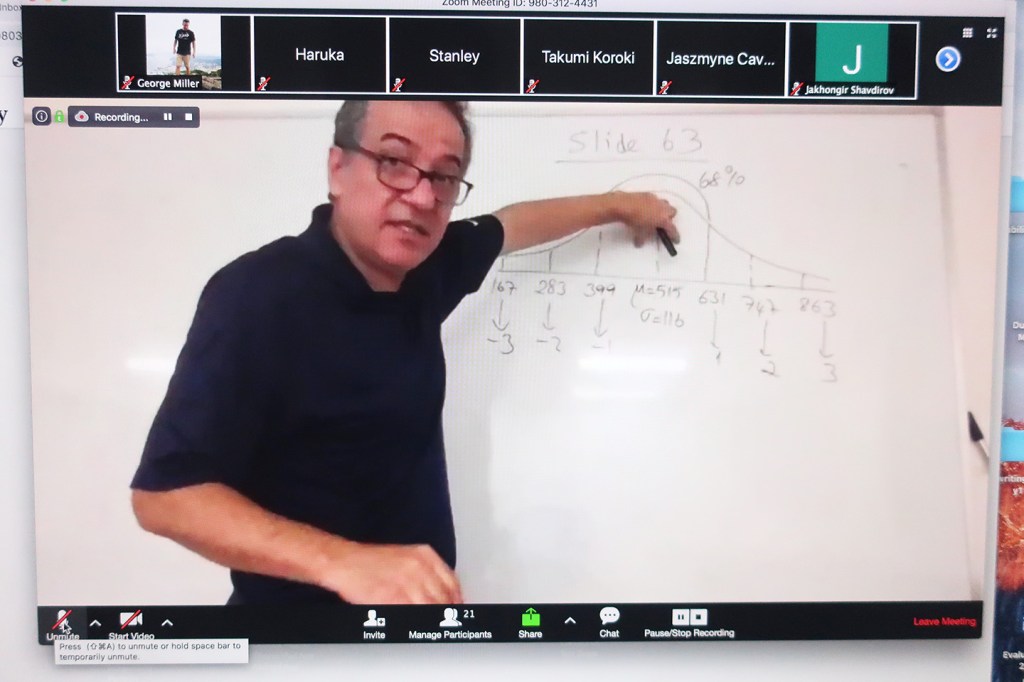
Sometimes live conferencing sessions work really well. You can explain material and have side conversations in the chat function. You can record the whole thing and share it with the whole class.
You could also pre-record lectures with slideshows and post them, and maybe present discussion boards where students can participate.
You could also just post slides or other documents, with instructions for students to do projects or exercises.
Whatever you do, you need to be available to students, especially if you are operating asynchronously. You should set up office hours when students can communicate with you in real time, preferably in a video conference. That element of humanity will be very important in building trust, respect and understanding.
My advice? Give students work away from class sessions and then, during class sessions, explain to them how the exercise ties into the learning objectives for the week.
That means that at the start of every class session, you need to explain the objectives for the day. At the end of every class session, you should summarize how everything discussed is connected to the class objective. Then, before departing, give the students a heads up for the next session. What are the readings? What are the key ideas coming up?
I’ve been sending Sunday evening or Monday morning emails preparing students for the upcoming week. I don’t want to drive them nuts with more emails but I need them prepared for classes.

Assessment in an online world?
Let’s just get this out of the way: Traditional tests do not work well online. You can do short quizzes and similar things via Canvas or other LMS but I would scrap longer tests.
You can’t ask students to keep their cameras on while they are taking tests because not all students have cameras and/or adequate wifi, and not all of them want you or others looking at their home life.
Some people have asked me about online proctoring services. They exist but they are costly. And really, could there be anything that says “I don’t trust you” more than a third-party person hired to stand guard?
We should exude trust and understanding. We should work within the confines (or freedoms!) or the medium.
Presentations work well online. Students can share their screens and show slideshows, documents or anything else open on their desktops.
Writing projects and short answer, take-home-style tests work well in the online environment.
The challenge for faculty is to develop numerous assessments, as students need feedback early and often, but not get overburdened by grading.
It’s probably best to create a variety of assessments – a few quizzes, some discussion board posting, a few short answer papers/tests and an occasional research paper (or the ilk).
Creating a learning community
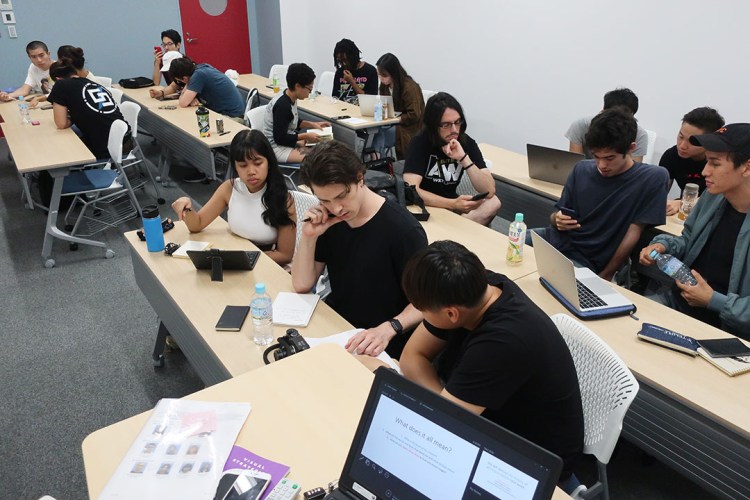
Students in an actual classroom will interact and relationships will form. They’ll share ideas inside and out of class. They’ll help each other survive and they’ll lend an ear to people with complaints. Actual support systems will develop from in-class experiences.
Online, things just don’t happen that organically. We have to facilitate such activity.
This is how I instructed students to
I encourage my students to interact online without me around. In fact, last week, I encouraged the students from all the majors at Temple Japan to create online communities (Slack, LINE, Google classroom, Snapchat, whatever) where they can help each other.
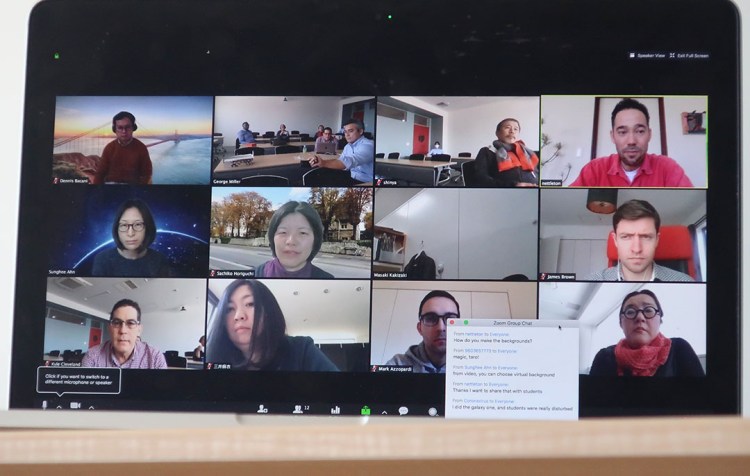
My online doctoral program cohort (below) has a Slack page and we are very active there. We help each other with assignments, discuss teachers and program stuff, and just offer encouragement to each other. It’s pretty great.
I’m not sure I’d recognize these people if I saw them on the street but if I ever heard of one of them having difficulties, I’d jump in to help in a heartbeat. We are a team, and I will do anything for my teammates.

Final thoughts
Online education can become very lonely, very quickly – for students as well as faculty. It’s just not the same experience as being in the classroom.
So, we shouldn’t treat it as such.
How do you maximize the resources in front of you? How can you harness the power of the Internet in order to get information into the brains of students?
Experiment. Try new things. Put stuff on your syllabi and then change plans during the semester as you see things working (or not).
In a traditional classroom, faculty can control the general climate. We can call on people and direct the conversation. We can see behavior patterns and catch problems before they fester.
In the online world, classroom management is much more difficult because instead of one room, faculty are overseeing as many rooms as there are students.
Faculty need to be hyper aware of students and their mindsets. We need to read the room (as it were) and navigate quickly when things falter.
In the online environment, students are in control of their learning.
We, as faculty, have to react to them.
 G.W. Miller III
One thought on “Lessons Learned During the Emergency”